
One of Modo’s six pillars is to be accessible.
Since mid April 2021 I have had the pleasure of leading the staff from the Alzheimer’s Society of York Region through a free 45 minute Modo class twice a month. Our sessions will conclude in mid August of 2021. At the time of writing this post I have two classes left to teach.
It has been such a phenomenal experience giving back to frontline workers who do such important work in the community. I am amazed by the organization in general. How ASYR values the health and well-being of their staff and not only allows for staff to take a 45 minute long class in the middle of their workday (11:00-11:45am), but encourages it, is remarkable. I truly believe that more workplaces should put such an emphasis on wellness initiatives during the workday. I’m sure they would see improvements in staff output and satisfaction.
My objective in this project was to offer an accessible yoga practice. Some of the barriers to taking a yoga class can be time and cost. As these classes were offered during the workday, encouraged by management and were free of charge, several of the barriers to practicing were eliminated upfront.
There are other barriers such as ideals that students perceive to be ‘true’ ‘right’ or ‘good’ yoga as learned from mainstream media depictions of yoga for white, thin, privileged women with hyper-flexibility. I tried to be deliberate in setting intentions that allowed students to let go of those expectations to look a certain way in a pose and to instead work towards honouring their own body. I reminded students to offer themselves grace, that it is okay for their practice to look and feel completely different from one week to the next. I also tried to include many variations and modifications for each pose to allow for accessibility for a range of fitness and flexibility levels. Such variations included things like keeping a toe on the mat for extra stability in balancing poses, adding a block under the hip during pigeon and doing a side-lying variation in lieu of sleeping hero.
There can also be mental and emotional barriers to taking a yoga class. I tried to lessen these barriers by allowing students to keep their cameras off if their comfort level didn’t involve being visible to those on the Zoom call with us. I tried to allow for warnings in poses that can bring up intense emotional reactions both viscerally and mentally such as providing a list of several sensations that you could be feeling during a heart-opening pose. I directed the students to use their breath as an anchor to help them ride those emotional waves and then provided a pause in a neutral position to reset before continuing the practice.
It has been humbling to receive their feedback after each session. Feedback is a crucial element in the Modo teaching realm. It is encouraging when you get positive feedback but can be disheartening when you receive negative commentary. I believe this to be a natural reaction to negative feedback. Learning to sit with the less-than-ideal reports, process the information and then incorporate it into your practice is a real journey.
I found as I read the positive feedback my chest would swell with joy and pride and a wave of happiness would wash over me. It was comforting and comfortable, like being cocooned up in a cozy blanket. It also felt surreal as if I couldn’t possibly be the person that they were talking about. These bits of personal experience given back to me from my students helped give me the confidence to keep going. I felt so honoured to be providing these classes. I truly believed that I was fulfilling my commitment to providing accessible yoga to my students.
On the flip side, the negative comments felt like a lead stone in my stomach. I noticed the all-too-common feelings of being an imposter, of not being qualified to offer these classes. Although logically, I know these things to be untrue- I am in fact fully qualified to teach a Hatha yoga class- it didn’t stop the associated feelings from momentarily flooding my system.
It is important to note that the negative commentary I received was significantly less than the positive feedback. That being said, we, as a species, are predisposed to focus on the negative as a means of survival. Thus these comments weigh heavier than their positive counterparts. Here is a snapshot of some general feedback given from 44 student feedback forms.
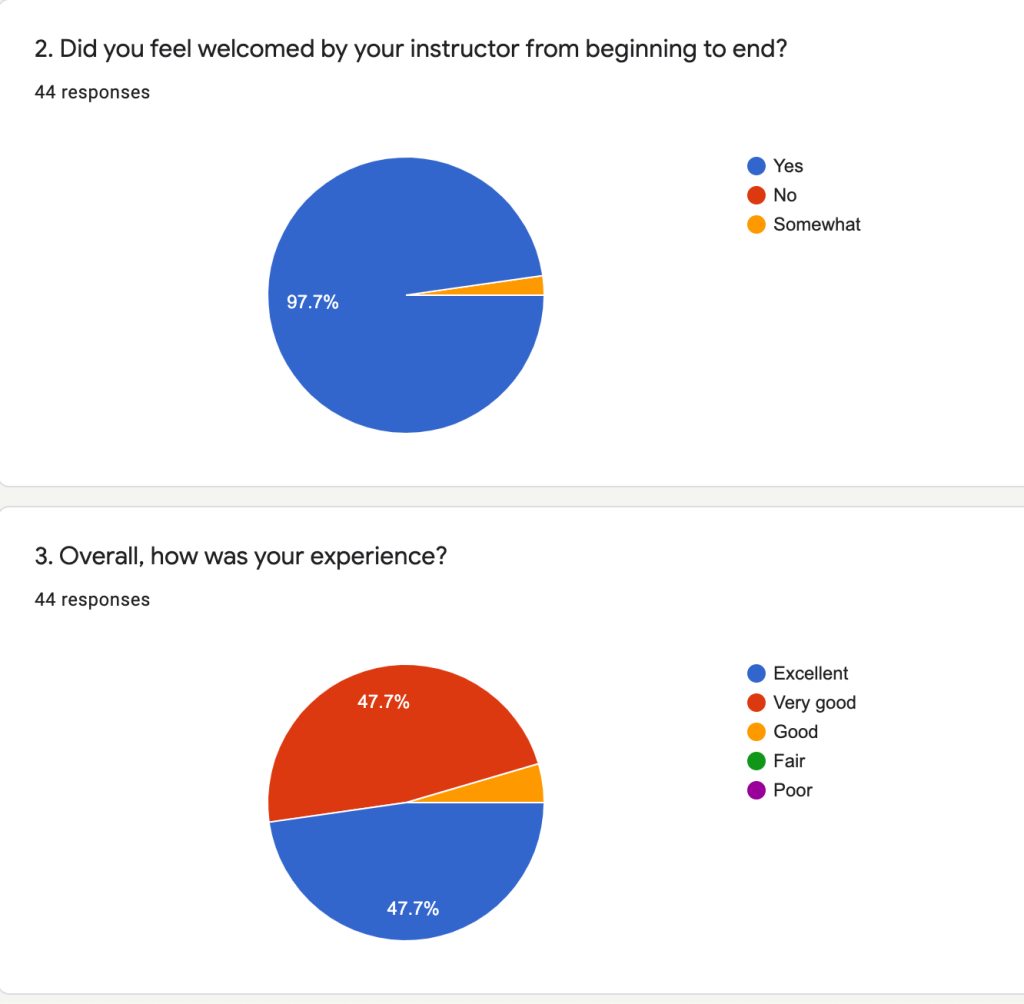
As the weeks went on I started to use the negative feedback as a focus in my meditation practice. Allowing the sensations to come, peak, crash and then recede like the tide kissing the shore. I started to focus more on how these critiques triggered me and how, if left unacknowledged, could easily lead into further stories of being “not good enough” or to stop teaching altogether. When I allowed myself to truly feel into the experience the words slowly stopped triggering me. Although still not comfortable to receive, I was no longer taking the feedback as a personal attack. It was at this point that I was able to actually work on incorporating said feedback into my teaching in a meaningful way.
I noticed that, as I made this shift personally, my students began to mention how helpful my cues were or how the intention I chose and wove through the class really resonated with them. I received comments on how my guidance was timed right for students to make the proper adjustments. Or how they appreciated the modifications offered.
I believe that the feedback I received was a gift twice over; initially, receiving it and allowing it to land, wether positive or negative, and allowing it to guide further instruction, and secondarily, recognizing the space it afforded my students to feel seen, heard and to offer them a sense of belonging knowing that their concerns have been listened to and I have tried to make adjustments as appropriate to best suit their needs.
I did have some feedback that still said that balance was difficult and that some poses were simply too hard for their aging bodies. This is something I am continuing to work on. I do offer several modifications for balancing poses but could work on incorporating the concept of Drishti more throughout the practice. Similarly, there are many variations I could cue involving chairs or other props to help with issues such as arthritis. This will be an area of on-going learning for myself to ensure I can best meet the needs of my students in all stages of the lifecycle.
It is so important to recognize that while teaching a group yoga class it is impossible to get to the complexities of every individual student’s needs and meet them 100% of the way. However, it is crucial that every student feels welcome, encouraged, and empowered to make the poses their own. As a teacher, my goal is to ensure the class is accessible to every single person in such a way that they feel physically, mentally and emotionally safe.
I believe that I have been successful in creating an accessible yoga offering for the staff of ASYR and hope to offer other free services to other important community agencies in future.
At the end of this experience I’m left with the question of why do I take the small doses of negative feedback so personally? Why is so much of my focus taken up by this when, as seen above, my students are generally quite pleased with my offering? Where else in my life does this behaviour show up? What other areas of my life may be affected by this internalized negative self-narrative? Why do I react so intensely to the positive feedback and why do those feelings pale so quickly beside their negative counterparts? The journey to finding the answers to these questions will certainly be a long one, but I anticipate that it will be well worth the ride.
This project has been an absolute pleasure to complete. Although the requirement was only to teach one class a week for a month I am very happy that I extended it further. I still do not feel ready to charge for my teaching at this time but as I finish up my projects I hope to move into owning my role as a 500 hour certified yoga teacher.
It is my sincere hope that throughout my career as a yoga instructor my students always feel that they belong in my class.
With love and gratitude,
Yoga Mama
 Yoga Mama Buddha Baby